Dreams and Visions in the World of Islam by Elizabeth Sirriyeh;
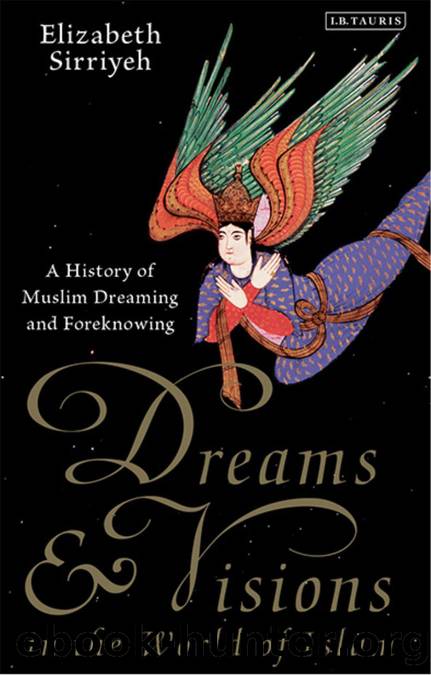
Author:Elizabeth Sirriyeh;
Language: eng
Format: epub
ISBN: 9780857738202
Publisher: Bloomsbury UK
Published: 2019-11-22T00:00:00+00:00
CHAPTER 6
âAND IF A WOMAN DREAMSâ
Gender, Vision and Power
It does not take long to realise that, among the thousands upon thousands of dreams and visions narrated and discussed in Muslim writings, the overwhelming majority are the dreams and visions of men. Among the minority that deal with women's visionary experience, it is not unusual to discover that an author's underlying interest is in the relevance of the event to men's affairs. The woman glimpses the unseen world as the mother, sister, wife, daughter, wet-nurse or slave of a significant male. We have already noted the visions of the Prophet's mother, Amina, preceding his birth. When dream manuals consider the meaning of a woman's dream, the oneirocrits commonly give predictions of marriage, divorce or childbirth. More rarely, female Sufi mystics have access to visionary encounters that elevate them to a status as major actors in their own right and their remarkable mode of âseeingâ mirrors that of their male counterparts and allows a wider range of outcomes for them.
Nevertheless, it is male authors and compilers who control the main output of dream texts, normally including those that feature women. Whether as religious scholars, Sufis or men of letters, they have the education and social position to decide the value of women's experiences and how they are to be presented. They can determine what is appropriate for women generally and for particular women, recognising some as exceptional figures of righteousness and open to the reception of supernatural contacts, while consigning others to routine domestic occupations or disapproved licentiousness. In this chapter we will be examining some of the efforts by male hadith specialists, biographers, historians and compilers of dream manuals, as they considered the significance of women's dreams and visions. Were their narratives and assessments, especially of dreams, utilised as one tool among many intended to keep women in clearly defined spaces within medieval Muslim society and remind their male readers that women had no place in the public sphere? On the other hand, were they perhaps no more than a natural representation of the everyday life of their time, in which the limitations of women's roles were acknowledged, alongside those of poor and vulnerable free males and slaves? Finally, was this male understanding of women's âseeingâ essentially a Muslim creation or was it to some degree a reflection of older regional norms and, in the dream manuals, a legacy from Artemidorus?
Women Dreamers, Seventh to Ninth Centuries
âAtika's Dream
In late February 624, shortly before the battle of Badr, the Prophet's paternal aunt âAtika is said to have been terrified by a powerful and disturbing dream. The oldest extant account of this dream is by Ibn Ishaq in his eighth-century biography of the Prophet, but there is some speculation that it may have been put into circulation by professional story-tellers at an earlier date.1 It was subsequently recounted by Waqidi and Tabari with some embellishments. Of course, there is the usual impossibility of knowing whether such a dream was ever dreamt and considerable doubts as to whether the tale has âthe ring of truthâ.
Download
This site does not store any files on its server. We only index and link to content provided by other sites. Please contact the content providers to delete copyright contents if any and email us, we'll remove relevant links or contents immediately.
The Vikings: Conquering England, France, and Ireland by Wernick Robert(84576)
Ali Pasha, Lion of Ioannina by Eugenia Russell & Eugenia Russell(40380)
The Conquerors (The Winning of America Series Book 3) by Eckert Allan W(39021)
The Vikings: Discoverers of a New World by Wernick Robert(37048)
Cecilia; Or, Memoirs of an Heiress — Volume 1 by Fanny Burney(32716)
Cecilia; Or, Memoirs of an Heiress — Volume 2 by Fanny Burney(32083)
Cecilia; Or, Memoirs of an Heiress — Volume 3 by Fanny Burney(32063)
Empire of the Sikhs by Patwant Singh(23199)
The Secret History by Donna Tartt(19466)
Hans Sturm: A Soldier's Odyssey on the Eastern Front by Gordon Williamson(18723)
Cat's cradle by Kurt Vonnegut(15550)
Pimp by Iceberg Slim(14785)
Sapiens: A Brief History of Humankind by Yuval Noah Harari(14552)
Norse Mythology by Gaiman Neil(13563)
Talking to Strangers by Malcolm Gladwell(13535)
Leonardo da Vinci by Walter Isaacson(13505)
4 3 2 1: A Novel by Paul Auster(12609)
Underground: A Human History of the Worlds Beneath Our Feet by Will Hunt(12226)
The Radium Girls by Kate Moore(12177)
